


.jpg)


Railway Therapy Practiced in Indonesia
While it might look like they are protesting against something or staging a gruesome mass suicide, the people of Rawa Buaya are actually looking to cure their illnesses by laying on the train tracks.
In western countries, most people think high levels of electric energy cause cancer, but to the inhabitants of Rawa Buaya, in Indonesia’s West Java, electricity is the ultimate cure. From young children to old folk, they all lie on train tracks passing through their settlement, hoping the electric energy from them will cure their various sicknesses. Not even the potentially lethal trains passing on opposite tracks don’t seem to be scaring these Indonesians away.

Railway Therapy Practiced in Indonesia

Railway Therapy Practiced in Indonesia

Smallest Watermelons
As consumers turn to micro-products, the “mini” trend seems to affect all areas of our lives. We keep seeing ever-smaller telephones, computers, cars, and apparently fruits are no exception.
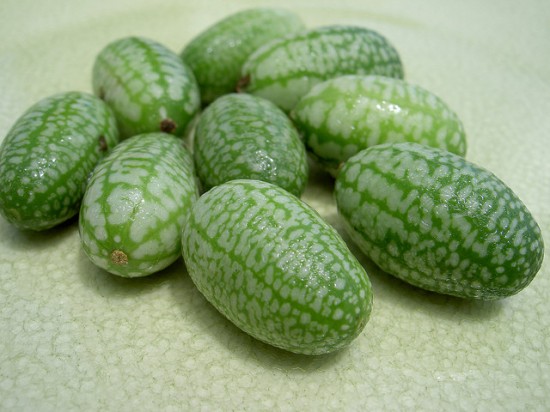
While they might look genetically-engineered, Pepquinos come from an ancient wild plant in South America, and are 100% natural. They are just 3-cm-long and 2 cm in diameter, but apart from their size, they look just like regular watermelons. But only on the outside, because once sliced, the juicy green flesh of a cucumber is revealed. They also have the crisp fresh taste of cucumbers and usually served in luxury restaurants, as appetizers, in summer salads, stir fried and even as a sorbet.
The rare Pepquinos were discovered and brought to Europe in 1987, by a Dutch company that later began producing them and selling seeds. They’ve only recently started cultivating them in the US and Asia, but their popularity in foodie communities is growing rapidly. The growth cycle of the Pepquinos plant is between 60 and 85 days, and a single string yields 60 to 100 fruit.
16 ounces of Pepquinos cucamelons cost $79, and that’s if you buy them from Koppert Cress, the Dutch company that produces them.
Smallest Watermelons

Smallest Watermelons

Smallest Watermelons

Smallest Watermelons

Guy Walks 1,000 Miles in the Name of Love
Liu Peiwen took his girlfriend’s challenge seriously, after she jokingly told him she would only marry him if he walked 1,000 miles for her.
Remember these lyrics from Scottish band The Proclaimers’ song: “But I would walk 500 miles, and I would walk 500 more, just to be the man who walked a thousand miles, to fall down at your door”? Apparently they inspired Liu’s girlfriend, 23-year-old Ling Hsueh, to say she would convince her mother to let her marry him, if Liu walked 1,000 miles. Before she could tell him she was only joking, her beloved had already bought a backpack and set off from the city of Anyang, Henan Province, towards Guangzhou, Guangdong Province.
The distance between their two cities is 1,600 km, exactly the 1,000 miles in Hsueh’s request, and since he enjoys walking and always wanted to see more of China, he gladly accepted the challenge. He expects it will take him around six weeks to complete his journey, and hopes the love of his life will be waiting for him at the end and will say “yes” when he pops the big question. “Life is short,” he said, “and for love, there’s no challenge too great.” He is now walking across China with only a rucksack and a red flag that reads “Valiantly, full of mettle, setting out to visit my wife’s mother”
Ling Hsueh says “”He’s such a fruitcake. I would have married him anyway and was only joking when I said he had to walk a 1,000 miles.” I guess the man wanted to be absolutely sure she would marry him. Who says romance is dead?

Guy Walks 1,000 Miles in the Name of Love

Chinese Girl Offers Her Virginity in Exchange iPhone
Is this a case of consumerism at its worst--or just a hoax?Business Insider is reporting that a Chinese teenager posted on Weibo, China's version of Twitter, that she would trade her virginity in exchange for an iPhone 4.
Reports of the girl's posting first surfaced last week in Biznewschina and the Korean Herald, which wrote that the girl posted a photo of herself along with basic personal information, because it's her "dream to own a iPhone 4 but her father won’t let her get one.”
The post, which many believe to be fake or a cruel prank played on the girl, has been met with a negative response and considerable criticism.
While it sounds unbelievable, this wouldn't be the first case of a Chinese teen going to extreme lengths for the latest technology.
Earlier this month a 17-year-old high school student named Xiao Zheng reportedly sold one of his kidneys for 20,000 yaun (about $3,100) to purchase an iPad 2 tablet.

Theatre Show Designed to Send Audience to Sleep
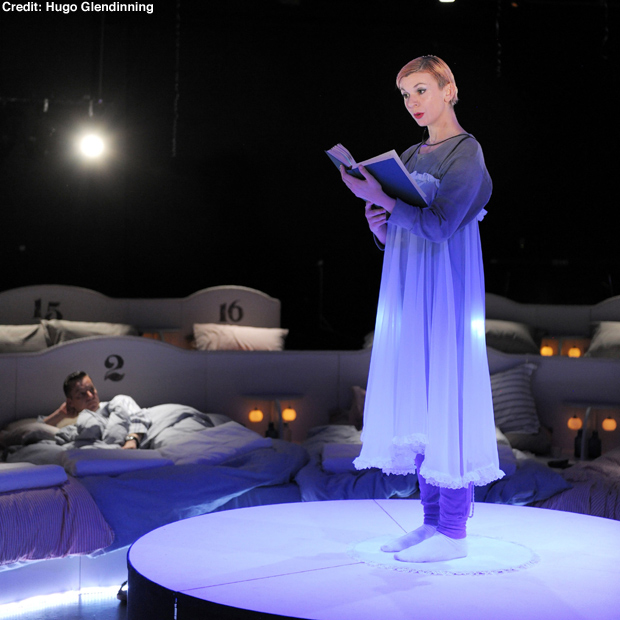
If you doze off at the theatre, it's normally a sign the show you're at isn't very good. But that not the case at the Barbican in London… they've got a show designed to send you to sleep.Their production 'Lullaby' has been specially created to send the audience to sleep and consists of things such as soothing storytelling and singing octopuses.
If that wasn't enough, the audience lie in pre-booked beds and attend the 'sublime sleepover' in their pyjamas - ready to be lulled to sleep by the slumber-inducing show.
After watching the action and falling asleep, the audience are left to sleep before being woken and served breakfast the following morning at 7.30am… which sure beats a Travelodge.
Producer Simon Casson says he has fallen asleep in shows including Lord of the Rings and Oliver so came up with the idea of created a specifically designed to send people to sleep.
So far no-one has stayed awake to the end of the show and the cast have to made do with snores rather than a round of applause.

Theatre Show Designed to Send Audience to Sleep
Theatre Show Designed to Send Audience to Sleep

CosquilleArte Tickle Spa
Relaxing is probably one of the last words people use to describe tickling, but at the CosquilleArte Spa, in Madrid, Spain, they actually use delicate tickling techniques to relieve clients’ stress.
I’ve seen some pretty bizarre spas since I began writing for OC, from resorts treating guests to wine, tea and sake baths, to clinics that use crude oil as treatment, but I never imagined someone would get the outrageous idea of using tickling as a stress-relieving therapy. But what I found even more ridiculous was that the idea actually worked and CosquilleArte has become one of the most popular spa venues in the Spanish capital. It wasn’t until later, when I learned the tickling methods have nothing to do with the terrible torture we all had to face from childhood friends, that this unusual form of therapy started to make sense.
Instead of jabbing their fingers into clients’ sides and armpits, like I’m sure you and your friends/siblings used to torment each other, the massage therapists at CosquilleArte gently trace their fingertips and soft feathers down their backs and other sensible areas, and adjust their touches according to how ticklish every person is. Although most first time customers clench when they’re touched, they leave the wacky establishment a lot more relaxed than when they came in.
CosquilleArte is the brainchild of Isabel Aires, a public relations specialist who loves to be tickled. She used to be tickled gently, by her father, so she would go to sleep, and one day she just thought “Why can’t I pay someone to do this, in the same way as I can pay for a massage?” She learned there was no tickling service available, so she decided to open the world’s first tickle spa. Together with two experienced massage therapist, Isabel had to invent tickle therapy, and judging by the success and popularity of CosquilleArte, I’d say they did a pretty good job.
The unique salon’s clientele varies from teenagers to 70-year-olds who pay €25 ($35) for a half hour of tickling, or €45 ($60) for a whole hour. It might sound like wasted money, if you’re still thinking about those dreaded armpit or sole tickles, but we’re talking about pleasurable, relaxing tickling, like your mother used to do to when you were a baby. It seems adults love the sensation of being tickled just as much as children, because Isabel Aires has already received calls about her tickle spa from as far as Russia and South America. She’s now considering setting up franchises and is discussing the possibility of making tickle massage available for in-room, for a large Spanish hotel chain.

CosquilleArte Tickle Spa

Doll Addict Collects $2 Million-Worth of Antique Dolls
Kathy Libraty, an antique doll collector from Brooklyn, New York, has spent the last 25 years searching for antique dolls, and now has an impressive collection of over 1,000 items that’s worth around $2 million.
Believe it or not, Kathy’s fascination with dolls didn’t start when she was a little girl. In fact she remembers she was more of a tomboy and had no real interest in dolls or any girly stuff. Born in France, she and her parents immigrated to the US when she was only 4. After graduating from Brooklyn College with a BA in Art, her passion for photography took her to Europe and the Middle East, where she took a real interest in history and old art. When she and her husband, Frank, bought an old Victorian house, Kathy decided to pursue her love for antiques and started attending country auctions. She was intrigued that people sometimes paid large amounts of money for wigless doll heads, broken limbs and crooked-eye dolls, but not enough to start spending money on them, herself.
It wasn’t until one day, 25 years ago, that Kathy Libraty really became addicted to collecting antique dolls. She and Frank were driving around the neighborhood when they saw a man emptying boxes of antiques into a dumpster. She saw a doll’s leg sticking out and told Frank to stop the car. They went up to the man and asked him if he was going to throw all those things away, and he just replied “Yeah, it’s all dirty old junk”, so they offered to take it off his hands. When they got home and looked through the “junk” they found a rare 24″ George Borgfeldt doll, several composition mama dolls, and a broken bisque Cuno and Otto Dressel Shoulder head doll. She often wondered what other treasures that man had thrown away in the dumpster that day, but the wonders she managed to get her hands on inspired her to go out into the world and discover her own priceless treasures.
In her quest to find more an more antique dolls, Kathy Libraty traveled more than 100,000 miles between America and Europe, where she found most of the items in her collection. Her dolls range from only 2 inches to over 3 feet in size, and cost from one meager dollar to $50,000. Husband Frank and daughter Elisa are also passionate about antique dolls, and help Kathy recondition them. Some of the dolls are restored and sold to other collectors, but some of them she just can’t bare part with.
Although she has over 1,000 rare antique dolls that take up most of the space in her Brooklyn house, and has reached a point where she has to sneak new arrivals past her husband, Kathy just can’t stop collecting dolls. And it turns out her addiction is financially beneficial, as the price of her antique dolls has already reached $2 million and can only go higher.

Doll Addict Collects $2 Million-Worth of Antique Dolls

Wunderland Kalkar - Popular Amusement Park
The Wunderland Kalkar (until early 2005, kernwasser-Wonderland ) is a recreational center , which from 1995 on the grounds of never put into operation and fast breeder reactor in Kalkar was built. Part of the system is the family theme park Kernie's family park . Managing the park Hennie van der Most.
Wunderland Kalkar is a unique amusement park built on the site of a never-used power plant, complete with a fast breeder reactor, in Kalkar, Germany.
Construction of the Kalkar nuclear plant began in 1972, but was constantly delayed due to technical difficulties and protests from those concerned about the safety of nuclear power. When it was completed, over 10 year later, authorities decided to pull the plug on the project, and the $4 billion complex was dismantled in less than a decade. The fast breeder reactor remained in place, and in 1995 Dutch entrepreneur Hennie van der Most bought what was left of the Kalkar plant for a mere €2.5 million and managed to turn it into a profitable amusement park visited by over 600,000 people, every year.
Wunderland Kalkar has around 40 rides, for children and adults alike, and a 400-bed hotel. Among the most interesting features of the park are the swing ride set up inside the cooling facility, and the climbing wall on its outer walls. Also, chairoplanes, quad bikes, go-karts and a whole bunch of other fun gadgets make trips to Wunderland Kalkar a blast for the whole family.

Wunderland Kalkar - Popular Amusement Park

Wunderland Kalkar - Popular Amusement Park

Wunderland Kalkar - Popular Amusement Park

Wunderland Kalkar - Popular Amusement Park

Bed Race in Knaresborough 2011
More than 25,000 people have gathered in Knaresborough to watch an event where wacky racers run through a town carrying someone in a bed.
The 46th annual Great Knaresborough Bed Race saw 90 teams of bed-carrying racers taking part, with some coming from as far as Germany and the USA.
Each team has to complete the gruelling three-mile course with their beds and while some racers go all out for speed, others are more fussed by the best dressed bed award.
We will let you work out which of these beds are built for speed and which took the course a a more leisurely pace.
A spokesperson for the organisers, the Knaresborough Lions, said they hoped the event had this year raised around £100,000.

Bed Race in Knaresborough 2011

Bed Race in Knaresborough 2011

Bed Race in Knaresborough 2011

Wine Cork
A bricklayer in the Czech Republic's picturesque South Moravian wine-making region is drawing legions of tourists curious to see the elaborate cork-decorated facade of his house.
"It has taken 180,000 wine corks in total -- halved, quartered," Miroslav Svoboda from Mutenice, a small town about 230 kilometres (145 miles) southeast of the Czech capital Prague, told AFP.
At first glance the house tucked among similar buildings on a hillside above the town seems as inconspicuous as the rest, but a closer look reveals the skilfully-made triangular and circular cork and pebble ornaments that adorn three sides of the house.
"On the fourth side in the yard, I've been working on a cork heart for three years now," said the 53-year-old Svoboda.
"The heart's for me," confided his rather timid girlfriend Ludmila, standing above a neat flowerbed by the decorated side of the house which was once covered in ivy.
Svoboda, a passionate drinker of red wine, got the corks from a local vintner -- "a sponsor who wants to remain unknown" -- to give himself a unique present for his 50th birthday after two years of busy work.
He is proud to have relied solely on his imagination to create the ornaments laid in tile glue, and he claims he was the only one to have done the work.
But Ludmila divulged "we cut the corks with vineyard scissors together."
The house has become a tourist attraction for visitors from the region as well as abroad who sign their names in an improvised guest book, which "includes one environment minister," Svoboda said.
"The first reaction was incredulous, uncomprehending. Now it's back to normal," added the bricklayer, before pausing for a few seconds to try to recall his motivation for the painstaking work.
"I haven't figured that out yet," he chortled.

Wine Cork

Wine Cork

Wine Cork

Wine Cork

Wine Cork

Wine Cork