


.jpg)


Hill of Crosses in Lithuania
The Hill of Crosses is a site of pilgrimage about 12 km north of the city of Šiauliai, in northern Lithuania. The precise origin of the practice of leaving crosses on the hill is uncertain, but it is believed that the first crosses were placed on the former Jurgaičiai or Domantai hill fort after the 1831 Uprising. Over the centuries, not only crosses, but giant crucifixes, carvings of Lithuanian patriots, statues of the Virgin Mary and thousands of tiny effigies and rosaries have been brought here by Catholic pilgrims. The number of crosses is unknown, but estimates put it at about 55,000 in 1990 and 100,000 in 2006.
Over the centuries, the place has come to signify the peaceful endurance of Lithuanian Catholicism despite the threats it faced throughout history. After the 3rd partition of the Polish–Lithuanian Commonwealth in 1795, Lithuania became part of the Russian Empire. Poles and Lithuanians unsuccessfully rebelled against Russian authorities in 1831 and 1863. These two uprisings are connected with the beginnings of the hill: as families could not locate bodies of perished rebels, they started putting up symbolic crosses in place of a former hill fort.
When the old political structure of Eastern Europe fell apart in 1918, Lithuania once again declared its independence. Throughout this time, the Hill of Crosses was used as a place for Lithuanians to pray for peace, for their country, and for the loved ones they had lost during the Wars of Independence.
Most recently, the site took on a special significance during the years 1944–1990, when Lithuania was occupied by the Soviet Union. Continuing to travel to the Hill and leave their tributes, Lithuanians used it to demonstrate their allegiance to their original identity, religion and heritage. It was a venue of peaceful resistance, although the Soviets worked hard to remove new crosses, and bulldozed the site at least three times (including attempts in 1963 and 1973). There were even rumors that the authorities planned to build a dam on the nearby Kulvė River, a tributary to Mūša, so that the hill would end up under water.
On September 7, 1993, Pope John Paul II visited the Hill of Crosses, declaring it a place for hope, peace, love and sacrifice. In 2000 a Franciscan hermitage was opened nearby. The interior decoration draws links with La Verna, the mountain where St. Francis received his stigmata. The hill remains under nobody's jurisdiction; therefore people are free to build crosses as they see fit.
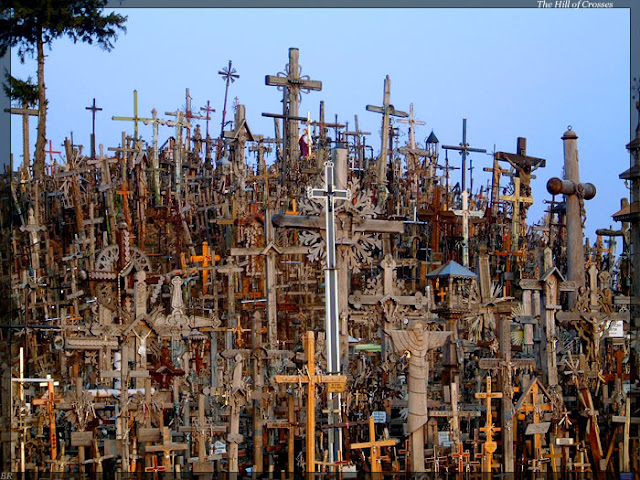
Hill of Crosses in Lithuania
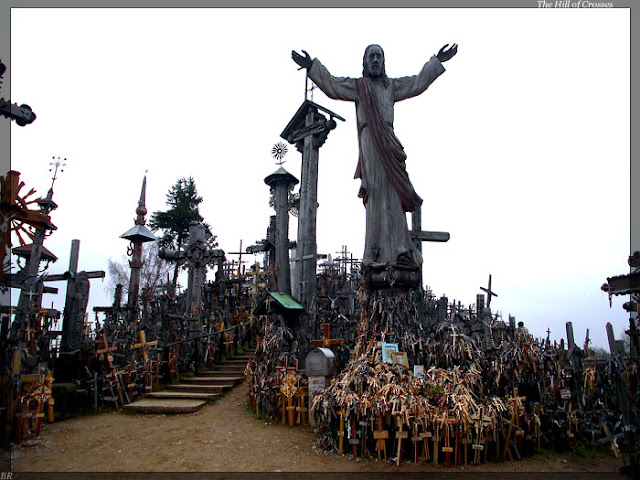
Hill of Crosses in Lithuania
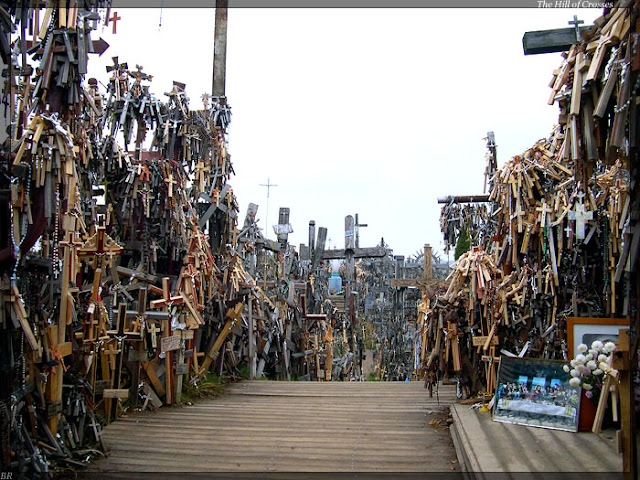
Hill of Crosses in Lithuania

Hill of Crosses in Lithuania
Hill of Crosses in Lithuania

Hill of Crosses in Lithuania

Hill of Crosses in Lithuania

Hill of Crosses in Lithuania

Hill of Crosses in Lithuania

Hill of Crosses in Lithuania

Hill of Crosses in Lithuania

Hill of Crosses in Lithuania

Hill of Crosses in Lithuania

Hill of Crosses in Lithuania

Hill of Crosses in Lithuania
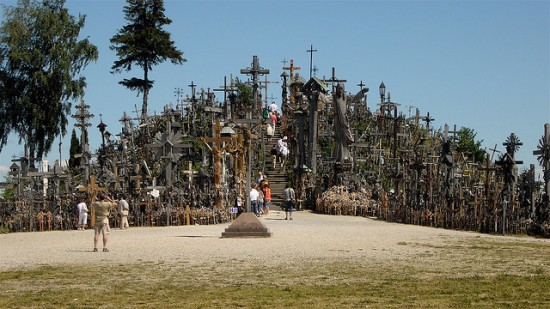
Hill of Crosses in Lithuania

Hill of Crosses in Lithuania

Rising105 meters into the sky, the Sanctuary of Truth is a one-of-a-kind gigantic structure that pays homage to the ‘Ancient Vision of Earth’, ‘Ancient Knowledge’ and ‘Eastern Philosophy’. It looks like a Thai temple or a palace, but it’s actually neither of them, so many people just look at it at as a monument to Thai craftsmanship.
Covering thirty two acres of land, on a rocky hilltop overlooking the ocean, the Sanctuary of Truth is the most magnificent sight in North Pattaya, and one of the most popular tourist attractions in Thailand. It is entirely carved out of teak wood and features the most beautiful and elaborate wood carvings I have ever seen, inspired by the four major artistic and philosophical influences in Thailand (Chinese, Thai, Khmer and Hindu). Buddha heads, sacred animals and all kinds of religious and philosophical themes are depicted in the thousands of wooden sculptures and carvings adorning both the interior and outside walls of the sanctuary.
The Sanctuary of Truth was the brainchild of Lek Viriyaphant, also known as “Khun Lek”, an eccentric billionaire who wanted to show people the rich architectural and cultural heritage of Thailand. He gave the green light for the construction of this unique monument in 1981, after researching traditional Thai architecture for many years. He christened it the Sanctuary of Truth and insisted it be constructed exclusively out of teak wood. That’s precisely the reason why construction is moving along so slow. Although the carvings look absolutely mind blowing, the 250 wood carvers working on the sanctuary every day can only do so much.
Construction is scheduled to be complete in 2025, but sadly, Khun Lek past away a few years ago, and won’t be able to admire his finished masterpiece. He did leave specific instructions, though, and work goes on according to his meticulous plan. Still a work in progress, the Sanctuary of Truth is already under siege from waves of tourists wanting to see the detailed hand-carved decorations first hand. So to keep at least some of them away, so the carvers could continue doing their job, a steep entrance fee of 500 Baht ($16) was set, but many would pay much more for the chance to see Pattaya’s wooden wonder.
The Sanctuary of Truth features four wings, one for each of the four beliefs that inspired its construction. Each of them manages to impress through the beauty of the designs and attention to detail, and it’s easy to lose track of time staring at all them trying to convince yourself they were indeed hand carved. The travel brochures speak of ‘understanding ancient life’, ‘life relationship with the universe’ and ‘common goals of life towards utopia’, which is a bit too much for the average tourist, but you don’t need to understand all that to appreciate the beauty that surrounds you at the Sanctuary of Truth.
As you might suspect, some of the outside carvings have already deteriorated after decades of harassment from the elements, but the carvers are working hard to repair any damage and fulfilling Khun Lek’s dream.


The Vigeland Park or Frogner Park is a public park located in Frogner, Oslo. It consists of various bridges, fountains and statues by Vigeland. The Vigeland Park is the largest park in the city and covers 320 hectares. The area was ready for Gustav Vigeland fountain in 1924 and the final plan was released in 1932 by the city-council. The park covers 80 acres (320,000 m2) and features 212 bronze and granite sculptures created by Gustav Vigeland. Together with the gates which are forged of granite and wrought iron, the Main Gate serves as an entrance to the park itself. It consists of five large gates, two small pedestrian gates and two copper-roofed gate houses, both adorned with weathervanes.
The Main Gate was designed in 1926, redesigned in the 1930s and erected in 1942. It was financed by a Norwegian bank. at Kirkeveien, the sculptural park consists of 7 parts.
* Frognerbroen with 58 bronse-sculptures and 4 groups of "lizards" in granite.
* The children-square with 9 small children-sculptures made of bronse.
* The labyrinth-square with the fountain.
* The floors
* The monolith-plateu with 8 artistic gates, sirclestairs and the 17 metre-tall Monolith.
58 of the park's sculptures reside along the Bridge, a 100 meter (328 ft) long, 15 meter (49 ft) wide connection between the Main Gate and the Fountain. All are clad in bronze and contribute to the “Human Condition” theme of the park. Here visitors will find one of the parks more popular statues, Sinnataggen or “Angry Boy”.
In 1940 the Bridge was the first part of the park to be opened to the public. Visitors could enjoy the sculptures while most of the park was still under construction. At the end of the bridge lies the Children’s Playground, a collaboration of eight bronze statues, all in the likenesses of children at play.
Originally designed to stand in front of Parliament (Eidsvolls plass), the Fountain was fabricated from bronze and adorned with 60 individual bronze reliefs. Portraying children and skeletons in the arms of giant trees, the Fountain suggests that from death comes new life. On the ground surrounding the Fountain lies an 1800 square meter mosaic laid in black and white granite. It took Vigeland a great deal of time to establish the monument: from 1906 to 1947.
The Monolith Plateau is a platform made of stairs that houses the Monolith totem itself. 36 figure groups reside on the elevation bringing with them the “circle of life” message. Access to the Plateau is made via eight figural gates forged in wrought iron. The gates were designed between 1933 and 1937 and erected shortly after Vigeland died in 1943.
At the highest point in the park lies the park's most popular attraction, The Monolith (Monolitten). The name derives from the Latin word monolithus from the Greek word μονόλιϑος (monolithos), derived from μόνος ("one" or "single") and λίϑος ("stone") implying the totem to be fabricated from one (mono) solid piece of stone (lith). Construction of the massive monument began in 1924 when Gustav Vigeland himself modeled it out of clay in his studio in Frogner. The design process took him ten months, and it is speculated that Vigeland had the help of a few sketches drafted in 1919. The model was then cast in plaster.
In the autumn of 1927 a block of granite weighing several hundred tons was delivered to the park from a stone quarry in Halden. It was erected a year later and a wooden shed was built around it to keep out the elements. Vigeland’s plaster design was set up next to it to give reference to its sculptors. Transferring of the figures began in 1929 and took 3 stone carvers 14 years to accomplish. On the Christmas of 1944 the public was allowed to admire The Monolith and 180,000 people crowded the wooden shed to get a close look at the creation. The shed was demolished shortly thereafter. The Monolith towers 14.12 meters (46.32 ft) high and is composed of 121 human figures rising towards the sky. This is meant to represent man’s desire to become closer with the spiritual and divine. It portrays a feeling of togetherness as the human figures embrace one another as they are carried toward salvation.
At the end of the 850-meter-long axis lies a sundial, forged in 1930, and finally the Wheel of Life, crafted in 1933-34.
The wheel is more or less a wreath depicting four people and a baby floating in harmony. It is a symbol of eternity, and implies the overall theme of the park: man’s journey from the cradle to the grave.


Our complete set of 642-617 test questions and F50-532 study guides you in exact way so you will pass your real 650-177 exam & HP2-Z18 with flying colors of mcp.
 Copyright 2010