


.jpg)


Fake Plastic Food In Japan
Fake food samples appear prevalently in the windows and display cases of food-serving establishments throughout Japan. Once made from wax, today they are usually made out of plastic. The plastic models are mostly handmade from vinyl chloride and carefully sculpted to look like the actual dishes. The models are custom-tailored to restaurants and even common items such as ramen will be modified to match each establishment's food. During the molding process, the fake ingredients are often chopped up and combined in a manner similar to actual cooking.
The craftsmanship has been raised to an art form and plastic food has been exhibited at places such as the Victoria and Albert Museum. Regular competitions are held in making fake food dishes out of plastic and other materials.
The plastic food manufacturers fiercely guard their trade secrets as business is lucrative; the plastic food industry in Japan, by conservative estimates, has revenues of billions of yen per year. A single restaurant may order a complete menu of plastic items costing over a million yen.
In recent years, Japanese plastic food manufacturers have been targeting markets overseas, such as China.
While some large companies exist, others are small shops with a single proprietor. They can be found in Kappabashi-dori, the food supply street in Tokyo. Factories can be found in Gujō, Gifu.
* Iwasaki Be-I, the biggest plastic food manufacturer in Japan, founded by Takizo Iwasaki in 1932
* Maiduru (Maizuru), another old and large manufacturer

Fake Plastic Food In Japan

Fake Plastic Food In Japan

Fake Plastic Food In Japan

Fake Plastic Food In Japan

Fake Plastic Food In Japan

Fake Plastic Food In Japan

Fake Plastic Food In Japan

Fake Plastic Food In Japan

Fake Plastic Food In Japan

Fake Plastic Food In Japan

Fake Plastic Food In Japan
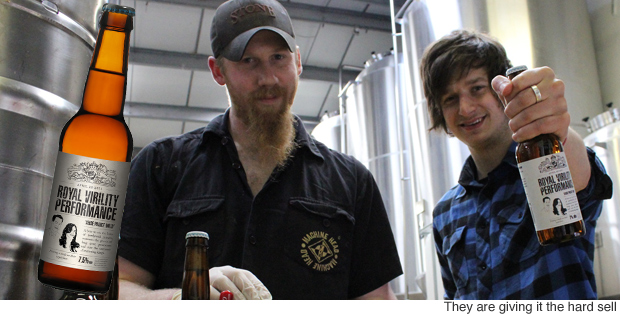
Viagra Beer
Our favourite brewers are at it again. And this time the crazy guys at Brewdog have created a beer called 'Royal Virility Performance' to mark the forthcoming Royal Wedding.
But as you'd expect from the people who created the world's strongest beer and served a brew in dead animals, this is no ordinary beer… it's said to be laced with viagra.
In fact they claim the aphrodisiac-filled India Pale Ale means that drinking three of the 7.5 per cent ABV bottles is the equivalent of taking one Viagra pill.
And it doesn't end there. Packaging on the bottles includes line like "Arise Prince Willy" and makers say they've sent some for the Prince to have a stiff drink on his wedding night.
James Watt, co-founder of BrewDog said: "We put a bottle in a jiffy bag marked ‘Prince Willy, Buckingham Palace’. As the bottle says, this is about consummation, not commemoration, so we hope he gets it.”
The craft ale will cost £10 per bottle, with all proceeds going to the charity Centrepoint, which Prince William supports and just 40 bottles of the beer will be sold via BrewDog.com.
For anyone wondering about the legality of selling a viagra-laced beer it's worth noting the label states it contains: "Viagra, chocolate, Horny Goat Weed and a healthy dose of sarcasm".

Viagra Beer

Dog Leash
We have a feeling using this dog leash in public could get you a bit of unwanted attention from the RSPCA and quite possibly police.
That's because Lebedev Studio designed it to look like you are shooting your pet pooch in the head as you take it for daily walkies.
Dubbed Povodokus, the gun-shaped handle contains a bright red lead which goes out freely as the dog pulls and reels in when you pull the trigger.
While creator Andrey Dyakov, says he came up with the idea as a concept, he told Newslite they've not ruled out taking it into production. Your move now PETA

Dog Leash

The protection - which comes with the slogan "Lie back and think of England" - are due to go on sale ahead of the April 29th wedding.
Makers say the condoms are a unique way to remember the royal wedding, adding that they 'combine the strength of a Prince with the yielding sensitivity of a Princess-to-Be.'
Each pack of three condoms comes with a leaflet including a photo of the happy couple (not like that) and is presented in a 'timeless souvenir heirloom collector’s box'.
Speaking of the bizarre commemorative gift, Hugh Pomfret from Crown Jewels Condoms of Distinction, added: "Crown Jewels Royal Wedding Souvenir prophylactics are a unique way to remember this great British occasion.
"All at Crown Jewels have worked tirelessly to craft these heirloom quality love sheaths. In years to come, they will be a timeless memento of a magical wedding day."

Spanish and Portuguese shoppers arrive at Desigual outlets in their underwear... to be clothed for free It’s not the sort of winter sale you would expect to happen in England.
But for theses Spanish and Portuguese shoppers the chilly weather was not so much of a factor.
They braved the mild New Year temperatures to cash in as clothing company Desigual promised: ‘Come in undressed and go out dressed.'
he wacky idea from the company, who was started by a Swiss in 1984 but has its headquarters in Barcelona, seems to have been a hit for those in the mood for a cheeky deal.
But there was a hitch: only the first 100 punters who arrived at selected branches were given the free stash.
At the Madrid store alone some 200 people queued outside ready to strip down to their underwear to take advantage of the shop's winter sale offer.
With the Spanish capital starting the winter sales five days before the traditional January 7 date, shoppers had to show their flesh in exchange for two free items of clothing - a top and bottom piece.
Pedro Soares and Ivan Silva claimed that they were the first to arrive at the Lisbon store at 1am in the early hours of Sunday morning, waiting eight hours until the doors opened and they were entitled to take home an outfit of their choice, gratis.
‘I have a woolly jumper and a pair of trousers, which would have cost €250 (£210),’ 20-year-old Mr Soares told Lusa News Agency.
‘I really like this brand and like this I can take the clothes without paying for them.’
Mr Silva said: ‘It was fun. We were the first to arrive and more people came during the night. When they opened the doors there was such a rush with people falling over each other to get the best clothes.’
Friends Jenny and Lisa from New Zealand had been waiting since before midnight outside the Madrid store and said it was a great opportunity to meet new amigos.
‘We have been here since 11pm with my friends,’ Jenny said. ‘New friends that we made here!’
Erica, from Brazil, earned her number one spot by waiting from 3pm the previous day and was happy with her choice, although she intended to buy more, in addition to the two free items.
‘I am number one and I have gotten a coat and trousers, but I am still picking things, there is a lot left to get though,’ she said.
Desigual were delighted with the interest the stunt gained for the brand – and rather than leaving those who did not make the top 100 shivering in next to nothing, they provided them with half-price discounts.
Public Relations officer Beatriz Almeida said that the initiative was aimed at marking the official start of the sales.
‘It went well,’ she said. ‘The brand aims to be original so we wanted this action to be different.’
Though the company has a store on Regent Street, according to the website there are no plans to offer a similar deal for London-based shoppers.


There's certainly a market for luxury cars and luxury condos. But what about luxury condoms?
A pair of self-described French aristocrats have launched a high-end condom company that aims to offer customers protection -- as well as an air of prestige.
The minds behind The Original Condom Co. say there is a demand for classier prophylactics in the same way there is a demand for luxury brands like Rolls Royce, Cartier and Dior.
"There [is] always a need for quality, good taste and beautiful objects," said vice president Count Gil de Bizemont, who co-founded the company with His Royal Highness the Prince Charles Emmanuel de Bourbon Parme after passing through the town of Condom, France.
"It is sexy to care about yourself and to want to pamper and provide yourself with the very best."
For de Bizemont, that means choosing neatly packaged prophylactics that come in a little black box instead of an ordinary foil wrapper.
"Would you be proud to have a traditional condom on your table when your mom visits you? With a nude woman on the box or something that says lubed or ribbed all over it?" he asked.
According to de Bizemont, many people judge a rubber by its cover.
"The luxurious presentation of our product removes any negative stigma associated with a woman who cares enough about herself to be sure to carry along an Original Condom box in her purse, or for a male to leave it on the nightstand without perceptions shifting about expectations, as they definitely should not nowadays," he explained.
De Bizemont says his company's condoms are far more upscale than the competition -- and it shows in the price tag.
The Original Condom comes in suede-lined black boxes purportedly "inspired by the world of jewelery," which contain three prophylactics for $13.50, or six for $20. Customers can buy refills for $2 apiece.
The company says it shares part of its earnings with nonprofits that fight HIV and AIDS, and shows its commitment to an eco-friendly business model by helping develop new forests and manufacturing its condoms on a rubber-tree plantation in an attempt to reduce carbon emissions by eliminating excess transport of raw materials.
The fancy condoms are already on sale online. In January, they'll be offered at some "higher-end retailers" and hotels, according to de Bizemont.
It appears there's nothing stopping the condom brand from growing -- if, in fact, sex does sell.


Penn Jillette's Masturbating Bathtub for Women Awkwardly-coiffed magician Penn Jillette is an inventor. His greatest triumph: a "hydro-therapeutic stimulator" for women with jetstreams directed to "stimulation points (e.g., the clitoris) of the female user when the female user sits in the seat." Meet the Jill-Jet.
Hey ladies, I know what you're thinking: There is nothing sexier than sitting in a giant vat of jetstreaming masturbation. That is why Penn Jillette invented the Jill-Jet.
As the 1999 patent explains, the Jill-Jet is "a spa that includes a dedicated stream of fluid that is directed to specific sensitive areas of a female's genitalia to promote pleasurable (and perhaps climatic) genitalia stimulation and therapeutic relaxation." (He meant "climactic," right?) As far as I can tell, the Jill-Jet is not currently in production, though I imagine there's some kind of after-hours Sharper Image crowd ready to swing it.

Source : Gizmodo

Mischer'traxler's automatic cake decorator uses a rotating platform to draw a flowery, spirograph-like design on its cakes. As a final touch, the mechanical arm drops sugar-pearls across the cake's surface.
The automatic cake decorator is part of an exhibit entitled "til you stop - how much is enough." You determine how decorated the cake gets by telling the machine when to stop. More icing please! (as long as it's of the cream cheese variety)


Source : Design Boom

SiGNa’s fuel-cell powered electric bike will run for 60 miles on a single charge. More impressive is that it runs on water.
The bike itself is really just a showcase for the fuel-cell tech from the energy company. The cells uses sodium silicide in the form of a sand-like powder. Add this to water and it “instantly creates hydrogen gas.” This hydrogen is then used to generate electricity. Because no hydrogen is stored, the cells are safe, and excess electricity is stored in batteries for an extra boost when you get to a hill. The cartridges are hot-swappable and are fully recyclable.
The main advantage (apart from the safety aspect) is that you can just swap-in a new cartridge when you need it, instead of having to stop to recharge (the units weigh around 1.5-pounds each, less than most batteries). You also get better range: a battery-powered bike typically gets 20 to 30-miles on a charge. The downside is infrastructure: you can find a power-outlet pretty much anywhere in the world. Try finding a compatible fuel-cell in a backwater general-store.
The current units can be designed to put out anything from 1-Watt to 1-Kilowatt. Their futire is probably not in electric bikes but in bigger transportation. Imagine driving your car into the gas-station, popping the hood and swapping in a fuel-cell, just Like Doc Brown drops a tube of plutonium into his time-traveling DeLorean.
Pre-orders for the cells cartridges are being taken by SiGNa. For a bike, you’ll probably have a long wait [UPDATE: The bikes will be available next summer]
Source : Wired

The world's first 3D Without Glasses television that doesn't require glasses has hit the market.
Toshiba unveiled the high-definition liquid crystal display 3D television that does not require the special glasses - one of the biggest consumer complaints about the technology.
The Tokyo-based company hopes this could be the breakthrough that brings 3D TV to the masses.
Glassess-less 3D: The Regza GL1 Series TV which combines image processing technology with a double convex sheet to render depth-filled images from any angle using parallax
Toshiba describes the TVs as being for 'personal use'.
Whether consumers embrace the new TVs remains to be seen. Many might be put off by the fact that they'll have to be very close to the screen for the 3D effect to really work - not to mention the steep price tag.
Electronics and entertainment companies around the world are banking on 3D to fuel a new boom in TV, movies and games.
Most 3D TVs on the market today rely on glasses to deliver separate images to each eye, which creates a sense of three-dimensional depth.
In its new TVs, Toshiba uses a 'perpendicular lenticular sheet,' which consists of an array of small lenses that direct light from the display to nine points in front of the TV. If a viewer is sitting within the optimal viewing zone, the brain integrates these points into a single 3D image.
Small: Masaaki Osumi of Toshiba with the 12-inch 3D TV and the 20-inch
'The result is a precise rendering of high-quality 3D images whatever the viewing angle within the viewing zone,' Toshiba said.
The system is similar to what's used in Nintendo's 3DS, the company's highly anticipated hand-held device that features glasses-free 3D gaming.
Toshiba will offer two sizes - 12 inches and 20 inches. The technology is not advanced enough yet to integrate into larger screens. Suggested viewing distance for the 20-inch model is 90 centimetres (35.4 inches) and 65 centimetres (25.6 inches) for the 12-inch size.
The TVs will go on sale in Japan in late December, Toshiba said. The smaller version will cost about 120,000 yen (£912), and the larger one will be double the price.
The company did not release details on overseas availability.


A non-stick chewing gum that dissolves within 24 hours went on sale yesterday.
Rev7, which has been formulated by British scientists, has the same taste and texture as normal gum, but is water soluble.
It can be removed easily from clothes using soap and water and tests show it can largely be cleared up by conventional street cleaning.
Any gum washed into the drains will break down into minerals and biodegradable materials.
The development could help cut the £150million annual chemicals bill to remove the sticky substance from the nation’s streets.
Professor Terry Cosgrove, who led the research at Bristol University, said the gum contained a special polymer which made it far less sticky.
‘The motivation to invent the product came from seeing chewing gum on the streets in this country and in America. It’s everywhere,’ he said. ‘The materials developed can be used for lots of other uses such as anti-graffiti paint and bacterial protection.
‘But because chewing gum is such an enormous problem at the moment we decided to target this as our main area.
‘This is like a dream come true for me, seeing academic research result in a real commercial product.
‘There are also several other exciting ventures in the pipeline.’
Revolymer, a company set up by Bristol University, used a £10million grant from investors to launch the product, which has now gone on sale in the United States.
Available in spearmint and peppermint flavours, it should go on sale here in 2011.
Normal chewing gum is made from synthetic latex, which is resistant to the weather and strongly adhesive

Lingerie Disguises : The bra that can be converted into a life-saving face mask An 'emergency bra' has been created by a Ukrainian scientist that can be turned into a face mask to protect against lethal chemical attacks or biological hazards.
The uplifting garment can be worn as intended then easily removed, separated into two and converted into two face masks that filters out harmful airborne substances - one for the wearer, and for a needy by-stander - or onlooker.
According to the inventor, Ukranian scientist Dr Elena Bodnar, it doesn't matter what your cup size is either as the masks are fully-adjustable to give the same level of protection.
Bosom buddy: Dr Elena Bodnar demonstrates her Emergency Bra at the MIT Museum in Cambridge, Massachusetts Litt and separate: Dr. Elena watches as a volunteer demonstrates dividing the two cups in the first stage of mask making
The Associated Press reports that Dr Bodnarm, who's now based in Chicago, initially got her idea after the 1986 Chernobyl nuclear disaster.
She explained: 'If people had had cheap, readily available gas masks in the first hours after the disaster...they may have avoided breathing in Iodine-131, which causes radiation sickness.'
She also claims the brassiere could be useful in the event of biological terrorist attacks.
Explaining how the garment works, she expanded:'To use the bra-mask, the wearer unsnaps the brassiere from under her shirt, which breaks it in two.
'Because each cup has hooks on its side, the strap is wrapped around the head and hooked to the cup, which goes over the mouth.'
Apparently, with practice, the bra can be whipped off and the mask effectively put on in seconds.
She added that bra-mask could be also be used during such disasters as fires, dust storms or a swine flu outbreak.
She said: 'You have to be prepared all the time, at any place, at any moment, and practically every woman wears a bra.'
There might be a 'counterpart device for men', Bodnar added, although it was not clear in what shape or form it would take.
Bra-vellous: The life-saving brassiere is now onsale to well-prepared lingerie fans Red alert: Break bras in case of emergency
The invention was first acknowledged at the 2009 Ig Nobel Prize awards, a spoof of the actual Nobel Prize, which acknowldge 10 scientific achievements that 'first make people laugh, and then make them think'.
It's organized by the U.S. scientific humour magazine Annals of Improbable Research and judged by actual Nobel laureates.
In her Ig acceptance speech, she joked: 'It takes only 25 seconds for average woman [sic] to use this personal protective device. Five seconds to remove, convert and apply your own mask, and 20 seconds to wonder who the lucky man is she is going to save.'
However, it only launched earlier this week after a year firming up 'safety engineering, economical design, and aesthetics'.
Dr Bodnar unveiled her life-saving lingerie at the MIT Museum in Cambridge, Massachusetts, on Monday.


Spray T-Shirt Designing - Make Own shirts Designs, Quotes Or Text you spray on Clothes that fit like a second skin ideas, try instant fabric Rummaging in a drawer, grabbing a T- shirts and slipping it over your head would certainly be simpler. But some of us are willing to put a little more effort into our wardrobes.
The result? A shirt that fits so snugly it looks as if it has been sprayed on to the body. Actually, it has.
Thanks to a liquid mixture made of cotton fibres we could soon be spraying ourselves into everything from T-shirts, dresses, trousers to swim-wear and hats.
Fabrican - literally fabric in an aerosol can - is the brainchild of Spanish designer Dr Manel Torres who has spent ten years working on his invention.
In a video demonstrating how it works, he sprays a blue and white T-shirt on to a model in just under 15 minutes.
Drying as soon as it hits his skin, the garment can be taken off, washed and re-worn.
Dr Torres teamed up with Paul Luckham, Professor of Particle Technology at Imperial College London, to create Fabrican, which consists of cotton fibres, polymers (the plastics which hold them together) and solvents which keep it in liquid form.
When you get bored with your creation it can be dissolved and the material used again to make something new or repair old designs.
Dr Torres said the idea was to be able to create clothes instantly and cheaply, all of which would be a perfect fit.
'I really wanted to make a futuristic, seamless, quick and comfortable material,' he said.
'To show science and technology can help fashion designers, I ended up returning to the principles of the earliest textiles such as felt, which were also produced by taking fibres and finding a way of binding them together without having to weave or stitch.'
Fabrican is still a couple of years from hitting the shelves.
Dr Torres is working on ways to create more forgiving shapes as not everyone likes their clothes clinging to every curve. He is also trying to minimise the distinct whiff of solvent about the garments.
And although some spray-on designs will be on show at London Fashion Week, the instant fabric could end up being used for everything from bandages to furniture upholstery.


Video : Spray T-Shirt
 Copyright 2010